Engineers rely on IV measurements to accurately characterize the electrical behavior of semiconductor devices – but what if the measurement process itself affects the results?
During conventional DC IV characterization, steady voltage and current conditions are applied to characterize a device. However, continuously applying these conditions can introduce effects that make it more difficult to accurately assess the device’s intrinsic behavior:
- Self-heating: As a device continuously conducts current during a DC measurement, heat builds within the semiconductor. The resulting increase in temperature can alter its electrical response, meaning the measured IV characteristics reflect both the applied electrical conditions and thermal effects rather than the device’s intrinsic behavior alone.
- Charge trapping: III-V devices such as GaN are particularly susceptible to trapping effects. Defects and imperfections within the semiconductor can temporarily trap electrical charge, altering the device’s electrical response and potentially degrading performance and long-term reliability. Characterizing these dynamic effects is therefore important for developing more predictive and robust device models.
Pulsed IV Characterization
Pulsed IV characterization instead applies short-duration gate and drain voltage pulses while measuring the device’s voltage and current response. The brief pulse duration minimizes self-heating, enabling accurate characterization under quasi-isothermal, or approximately constant-temperature, conditions.
Controlling pulse and bias conditions also allows engineers to capture dynamic device behavior and model charge trapping effects. By comparing the device response under different conditions, engineers can better assess its intrinsic behavior and extract parameters for compact and behavioral models.
Accurate Pulsed IV characterization presents its own measurement challenges. The system must generate short-duration pulses with fast rise and fall times while maintaining signal integrity, ensure voltage and current waveforms settle without distortion, and precisely capture the DUT response during the brief pulse. These requirements make precise pulse timing and measurement control critical to accurate characterization.
Advanced Pulsed IV Measurement Solution
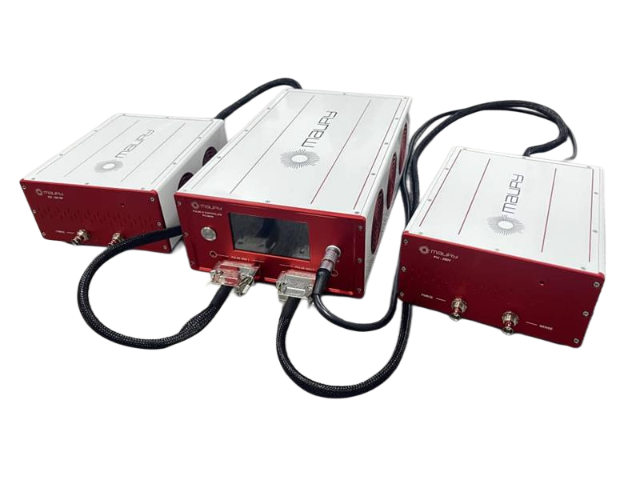
Designed to meet these challenges, the Maury Microwave Pulsed IV measurement system consists of three modules designed for accurate DC and Pulsed IV device characterization. The PIV Main serves as the high-voltage AC/DC power supply and main controller, while the PIV-30V-BP and PIV-280V provide Pulsed IV sourcing and measurement for the gate and drain, respectively.
Key capabilities include:
- Wide voltage and current coverage: The gate module supports ±30 V and ±1.5 A pulsed current, while the drain module supports up to 280 V and 40 A pulsed current, providing wide voltage and current coverage for characterizing semiconductor devices.
- Fast pulse performance: The system supports pulse widths down to 200 ns. In Fast mode, typical rise and fall times are as low as 25 ns at the gate and 30 ns at the drain.
- High-resolution measurements: The system provides 10 ns time resolution for precise DC and Pulsed IV measurements.
- Expanded device characterization: Measurement and pulsed triggers support S-parameter and fast power measurements alongside Pulsed IV characterization.
Gate Pulse: 1 µs
Measured −5 V gate pulse with a 1 µs pulse width.
Gate Pulse: 500 ns
Measured −5 V gate pulse with a 500 ns pulse width.
Drain Pulse: 1 µs
Measured +25 V drain pulse with a 1 µs pulse width.
Drain Pulse: 500 ns
Measured +25 V drain pulse with a 500 ns pulse width.
Pulsed IV Characterization with InsightProTM
The PIV measurement system integrates with Maury InsightPro™ Device Characterization Software, supporting DC IV, Pulsed IV, Pulsed S-parameter measurements, and waveform analysis. InsightPro provides tools for Pulsed IV bench setup, pulse timing configuration, measurement visualization, and analysis within a single software environment.
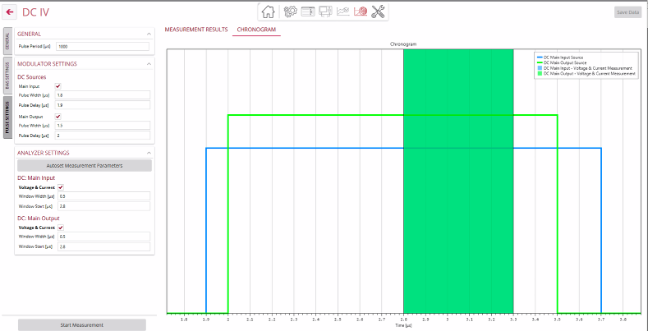
The PIV Series and InsightPro provide an integrated solution for accurate DC and Pulsed IV characterization of semiconductor devices under quasi-isothermal conditions.
Pulsed IV Measurement of a GaN DUT
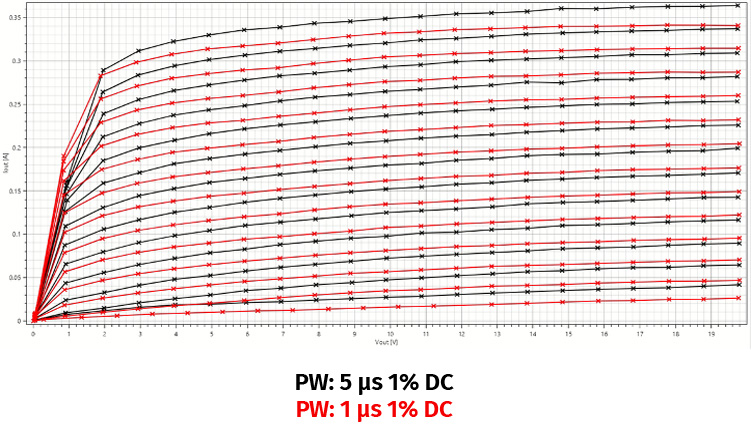
The graph below shows an example of a Pulsed IV measurement for a GaN DUT performed with the Maury PIV Series and generated using InsightPro. For each curve, the device is held at a particular gate condition while the drain voltage (X-axis: Vout) is varied and the resulting drain current (Y-axis: Iout) is measured. Repeating the measurement at different gate conditions forms the graph’s family of IV curve.
The measurement is repeated using two pulse widths – the black curves represent 5 µs pulses, while the red curves represent 1 µs pulses, both at a 1% duty cycle. Comparing the paired curves shows how the measured IV response differs between the two pulse widths.