Accurately characterizing RF devices often requires testing beyond standard 50 Ω conditions, as performance depends on the impedance presented to the device. To evaluate this behavior, engineers use load pull techniques, where impedance is intentionally varied using impedance tuners.
Slide-Screw Tuners
One common type is a passive slide-screw impedance tuner. It typically consists of a precision 50 Ω slabline, which is a flat transmission line formed by two parallel metal plates. The slabline includes a center conductor (airline) running between them, and a movable metallic probe (or slug) inserted from above.
The probe can move both vertically and horizontally within the slabline. The interactive illustration below demonstrates these two mechanical adjustments.
Slide-Screw Tuner Probe Movement
Move X to shift the probe along the slabline. Move Y to adjust probe depth.
End View
Side View
How Probe Movement Controls Impedance
Impedance control is achieved by moving the probe:
- Vertical movement (magnitude): When the probe is fully withdrawn, the signal passes through with minimal reflection (near 50 Ω). As the probe is lowered toward the airline, it increasingly interacts with the signal’s electric field, creating a reflection. The deeper the probe, the greater the magnitude of the reflection (Γ), reaching high mismatch (high VSWR) at maximum insertion.
- Horizontal movement (phase): When the probe is closest to the DUT, the reflected signal returns with minimal phase shift. As the probe is moved along the length of the slabline, the distance between the probe and the DUT increases, causing the phase of the reflection to rotate.
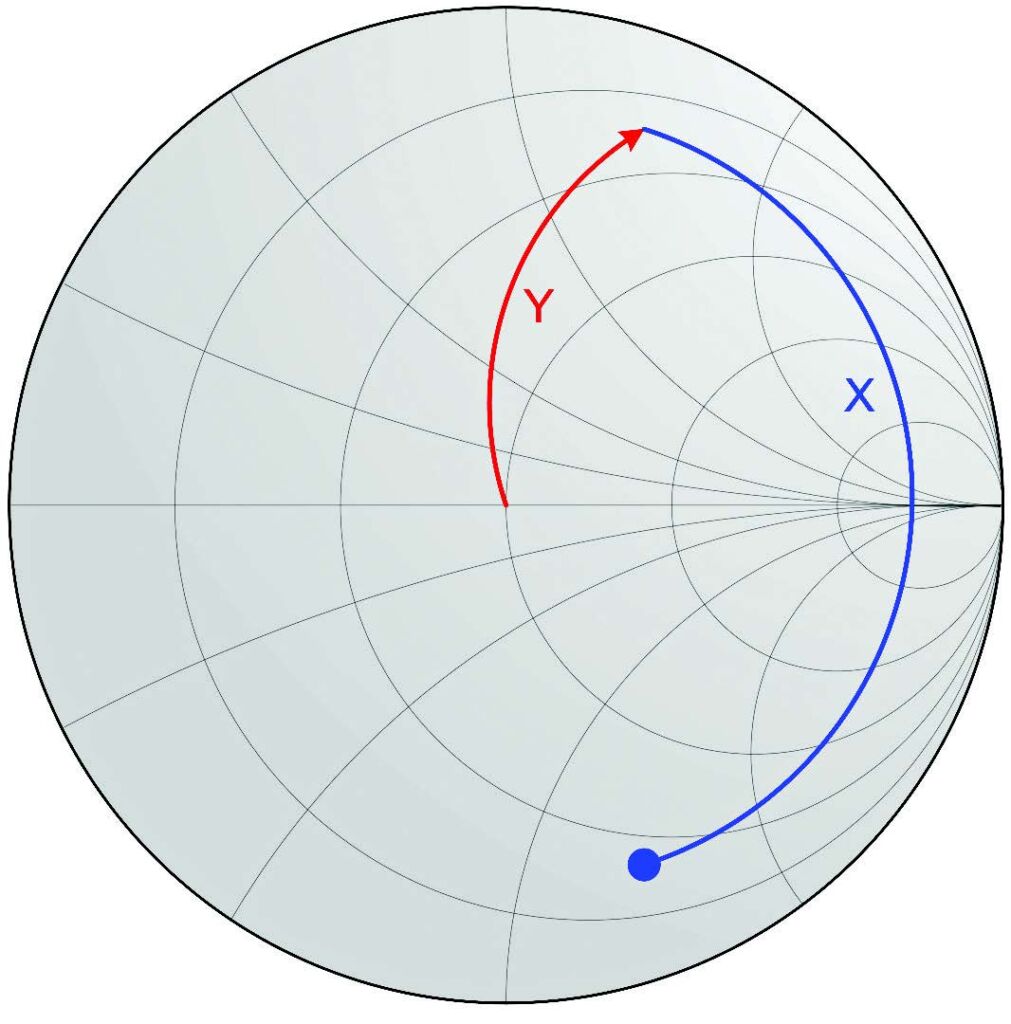
By moving the probe up and down, left and right, users can present nearly any impedance to the DUT to achieve full Smith cart coverage for comprehensive characterization.
Impedance Tuning Solutions
Controlling impedance across the Smith chart enables load pull characterization, where device performance is evaluated under realistic, non-50 Ω conditions. By sweeping impedance and measuring response, engineers can identify the operating points that maximize power, efficiency, or linearity.
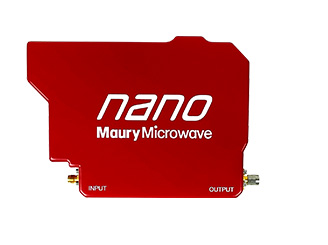
Maury Microwave impedance tuner solutions include active tuners, automated tuners, cryogenic tuners, manual tuners, and stub tuners. These devices allow engineers to move beyond ideal 50 Ω conditions and characterize devices as they behave in real-world RF systems.