

Understanding the Essentials
Phase noise — the short-term, random phase fluctuations in electronic devices and systems — significantly impacts performance in critical applications, such as radar and digital communications networks.
The “Understanding Phase Noise Measurements” poster is your go-to resource for demystifying all things phase noise.
Download your copy for concise answers to questions spanning phase noise fundamentals to confidence factor vs. noise floor to cross correlation.

What's the Difference?
Additive vs. Absolute Measurements
The poster highlights advanced phase noise analysis solutions, such as those featured in Maury low phase noise analysis, which enhance an engineer’s diagnostic and debugging capability, enabling a thorough assessment of phase noise performance in complex systems and devices.
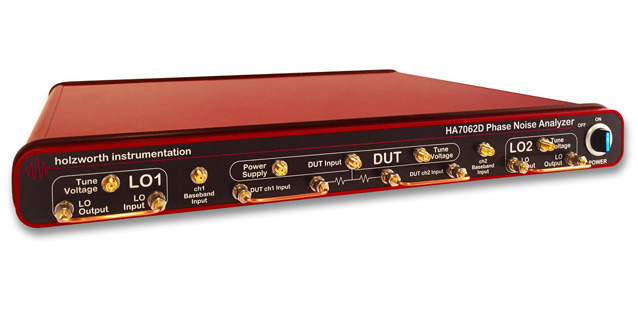
Key phase noise analyzer features for optimal testing include:
- Measurement accuracy, reliability, and repeatability
- Real-time cross correlation
- Reconfigurable front end
- High-speed measurements
- Measurable instrument noise floors
High-performance phase noise analyzers can effectively quantify the magnitude of phase noise with automated absolute and residual/additive measurements.
Residual/additive: Additive phase noise refers to the phase noise introduced by subsystems or specific components within a signal chain, characterizing devices or systems that signals pass through, rather than those that generate a waveform natively. This type of analysis targets components such as mixers, amplifiers, and other multi-port signal processing devices.
Absolute: Pertaining to individual components or the overall system, this type of phase noise measurement characterizes the performance of signal sources (e.g., signal generators, oscillators, etc.). Absolute phase noise compares the device under test (DUT) to local oscillators (LOs), which means the LOs must have better phase noise than the DUT.
Must-read resourceWant to Learn More?
Want to Learn More?
Download our Poster
The poster, “Understanding Phase Noise Measurements,” provides a clear and concise overview of key phase noise concepts, including its impact on system performance, measurement techniques, cross correlation, confidence factor vs. noise floor, and advanced analysis solutions.
Explore phase noise fundamentals using this insightful visual guide from Maury Microwave.