

Emulating Complex RF Link Conditions for 5G NTN
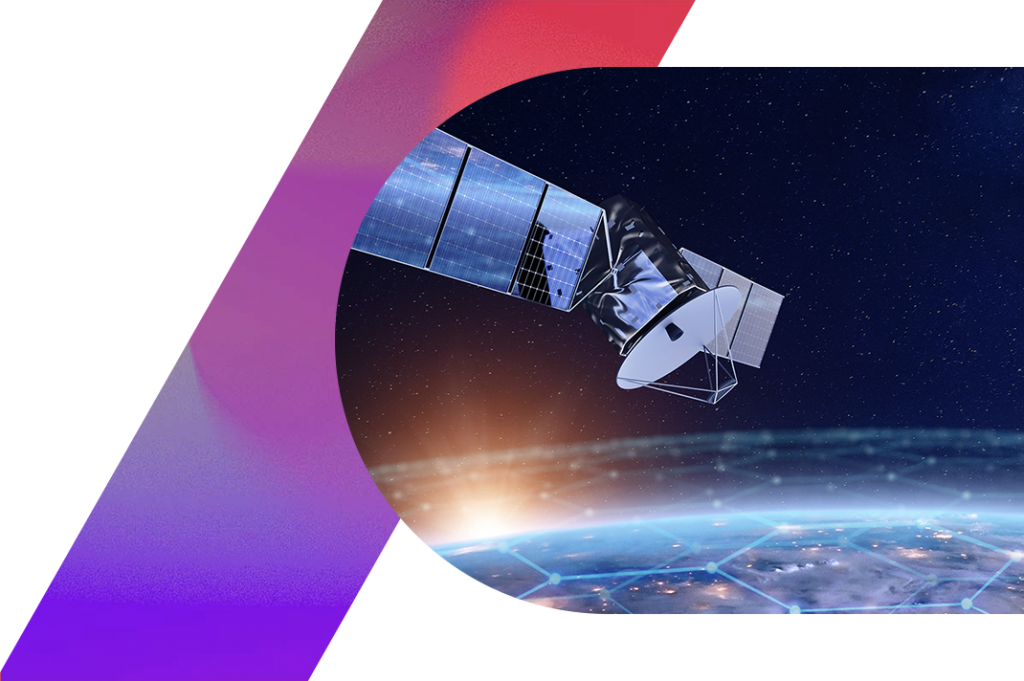
5G non-terrestrial networks (NTN) use LEO, MEO, and GEO satellites and airborne platforms to extend connectivity beyond the limits of traditional, ground-based infrastructure. Operating in complex, dynamic environments, 5G NTN experience Doppler shift, propagation delay, atropoisomeric disturbances, and hardware-induced impairments, requiring advanced channel emulation to evaluate performance under realistic conditions while still in the lab. For deeper insight into satellite link emulation for 5G NTN, read the white paper, “How Are 5G Non-Terrestrial Networks Driving Satellite Link Impairment and Hardware-In-The-Loop Emulation?”
Advanced Channel Emulation
Critical Test Capabilities for NTN Deployment
State-of-the-art channel emulation solutions can precisely modeling 5G NTN link conditions as requirements continue to evolve. The ACE9600 can scale up to 16 synchronized channels (four chassis with four channels each) to support realistic testing of large satellite constellations and complex NTN architecture. Configuration options include:
- Bandwidths of 72, 125, 300, or 600 MHz per channel (no need for carrier aggregation)
- Programmable delay, attenuation, phase shift and signal/carrier Doppler
- Optional internal RF converters
- Optional additive White Gaussian noise (AWGN)
- Optional multipath (12 paths per channel, Rayleigh, Rician, CW, etc.)
- Optional hardware-in-the-loop impairments, IMOX/OMUX, amplifier compression (AM/AM & AM/PM), and programmable phase noise

Must-read resourceWant to Learn More?
Want to Learn More?
Read our White Paper
Discover how the Maury Microwave ACE9600 replicates link- and hardware-induced impairments to test and validate various satellite orbital paths and 5G NTN in the white paper, “How Are 5G Non-Terrestrial Networks Driving Satellite Link Impairment and Hardware-In-The-Loop Emulation?”