Clock quality plays a critical role in the performance of today’s high-speed digital systems, influencing timing, jitter, and overall signal integrity.
This blog explores the role of phase noise in high-speed clock testing, how phase noise affects clock stability and jitter, and the measurement techniques engineers use to characterize clock performance.
High-Speed Digital Clocks
High-speed digital systems such as PCIe®, DDR memory, USB, and high-speed serial connections rely on precise clock signals to maintain timing accuracy and data integrity. These clock signals provide the synchronization needed to coordinate data transfer and processing throughout the system.
As digital interfaces continue to push to higher operating frequencies and faster data rates, greater demands are placed on maintaining clock stability. With timing margins getting tighter and tighter, even small phase variations in a clock signal can affect system performance, introducing jitter and increasing the risk of bit errors.
Phase Noise in Clocks
Real-world clock signals are not perfect and contain small phase fluctuations that cause them to deviate from their ideal behavior. These random phase changes appear as noise around the carrier signal when viewed in the frequency domain, referred to as phase noise.
Phase noise measurements are used to quantify the frequency stability of a clock signal, providing valuable insight into clock quality and overall timing performance. By measuring phase noise at different frequency offsets, engineers can assess clock stability; identify the contributions of clock generators, reference oscillators, and phase-locked loop (PLL)-based clocks; and better understand how these sources contribute to overall clock jitter.
Measuring Phase Noise
To characterize these effects, engineers can measure both the absolute phase noise of a clock source and the additive phase noise introduced by each circuit in the clock distribution path.
Absolute phase noise measurements
Absolute phase noise measurements characterize the intrinsic phase noise of a clock source, oscillator, or synthesizer. It addresses the following: How noisy is the clock source itself?
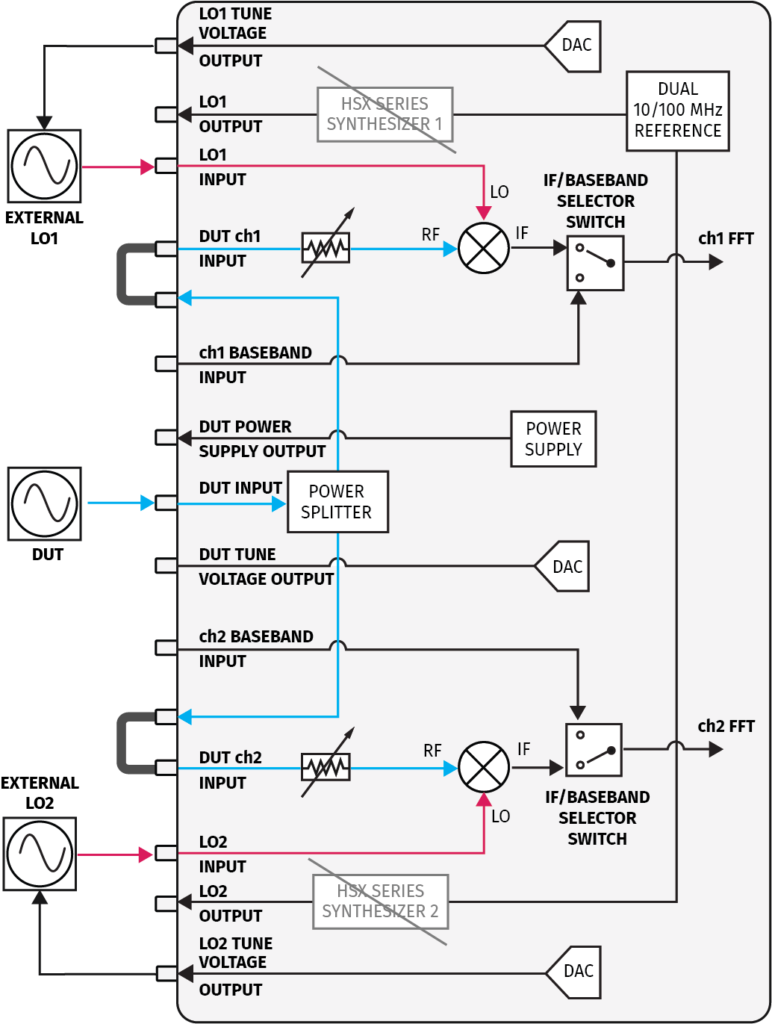
Depending on the performance of the DUT, absolute phase noise measurements may use either the phase noise analyzer’s internal local oscillators (LOs) or external LOs. While internal references are suitable for many clock generators and synthesizers, ultra-low-phase-noise clock sources may require external references with lower noise floors to ensure accurate characterization.
The diagrams below illustrate two measurement configurations, showing how an analyzer can use either its internal LO or external sources to perform absolute phase noise measurements.
Additive phase noise measurements
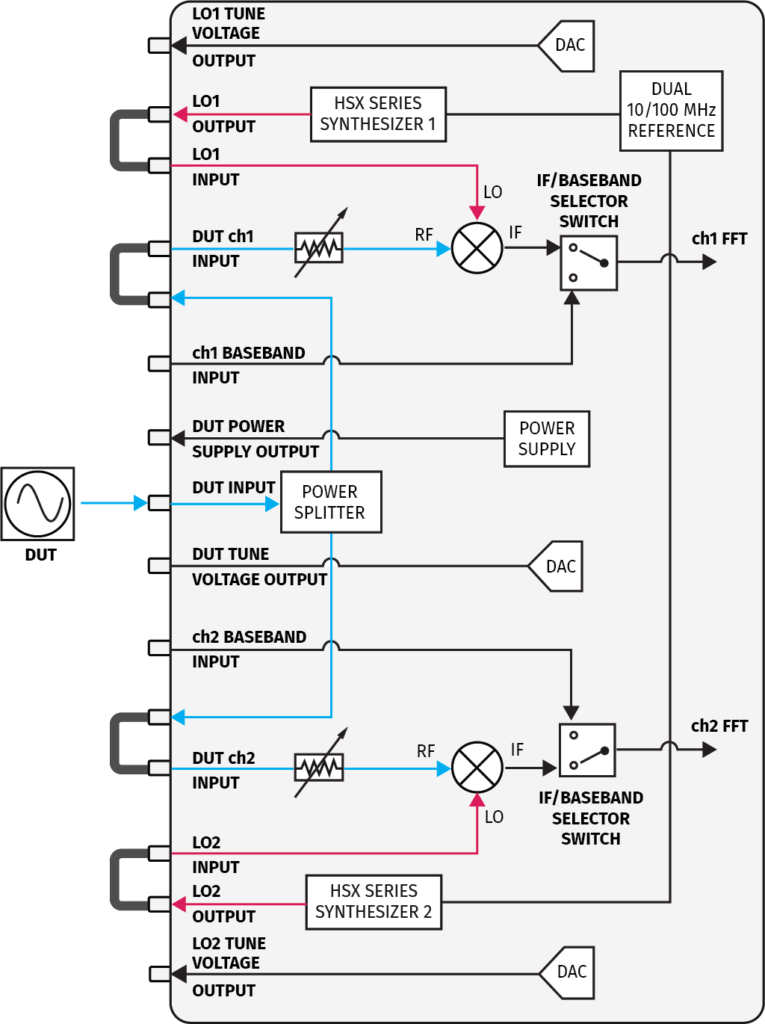
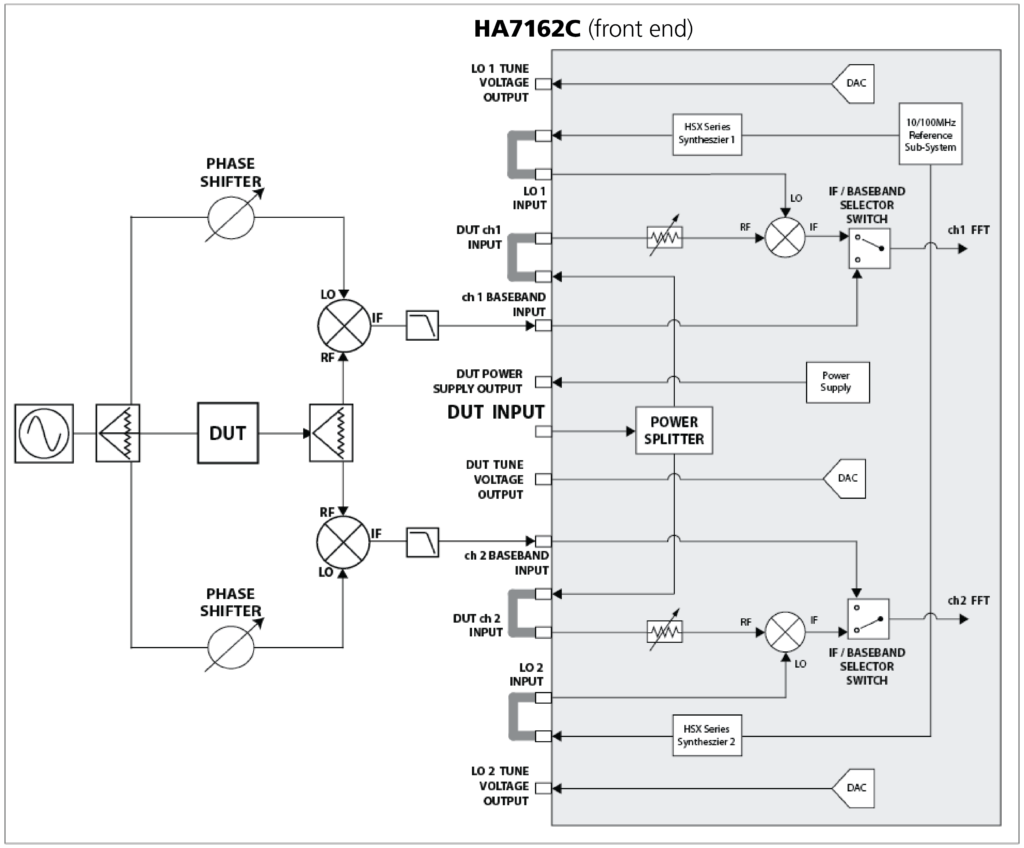
Additive phase noise measurements are used to determine how much noise is introduced by subsystems or individual components in the signal path. It aims to answer the question: How much additional noise did this device add to my clock?
The diagram below illustrates a typical additive phase noise measurement setup, in which the signal is routed through the DUT and compared against a reference path to characterize the noise introduced by the device.
Maury Phase Noise Analyzers
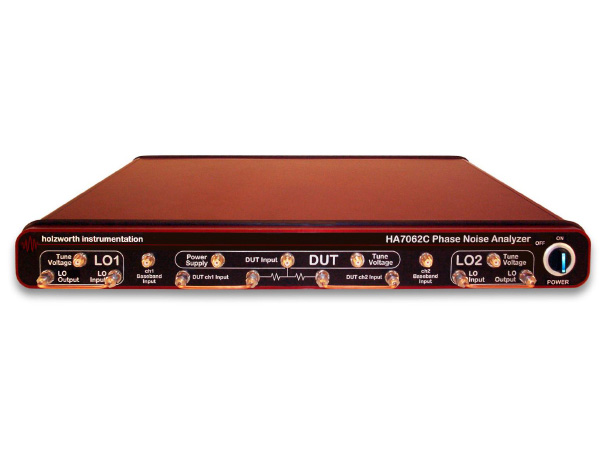
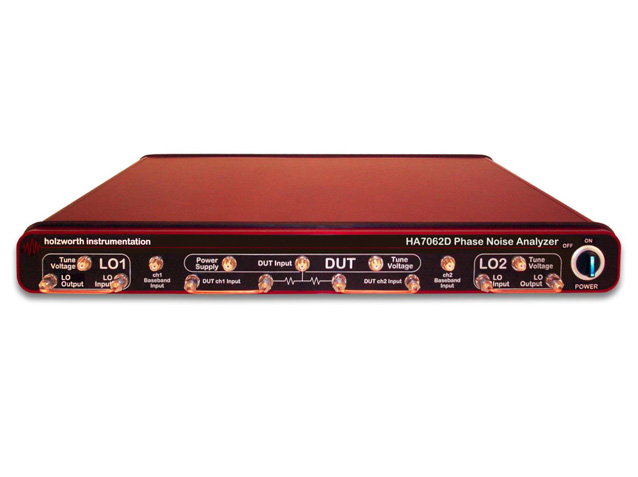
The Maury Microwave HA7162C and HA7162D Real-Time Phase Noise Analyzers enable engineers to characterize the phase noise, spectral purity and frequency stability of clock generators, reference oscillators, synthesizers, PLL-based clocks, and other RF signal sources.
Features include:
- Measurements from 1 MHz to 40 GHz (configuration dependent)
- Measurement bandwidth up to 100 MHz with offset-frequency coverage from 0.1 Hz to 100 MHz
- Real-time dual-core cross-correlation
- High-performance internal LOs
- Various measurement modes, including internal or external LO operation, additive phase-noise testing, AM-noise measurement, and spurious analysis
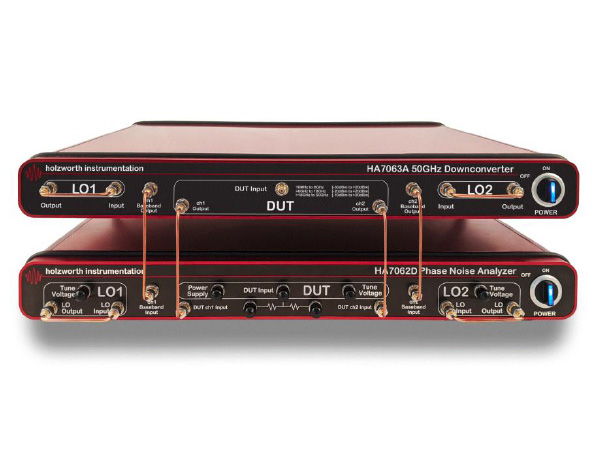
- Frequency extension up to 50 GHz using the Maury HA7163A heterodyne downconversion system
Through absolute and additive phase noise measurements, engineers can distinguish the noise generated by a clock source from noise introduced by downstream components. When combined with jitter and time-domain analysis, these measurements provide deeper insight into clock performance and the sources of timing variation throughout a system.
Maury phase noise analysis solutions help engineers characterize clock oscillators and signal sources, evaluate performance, validate designs, and turn complex signal behavior into clear, actionable insight.