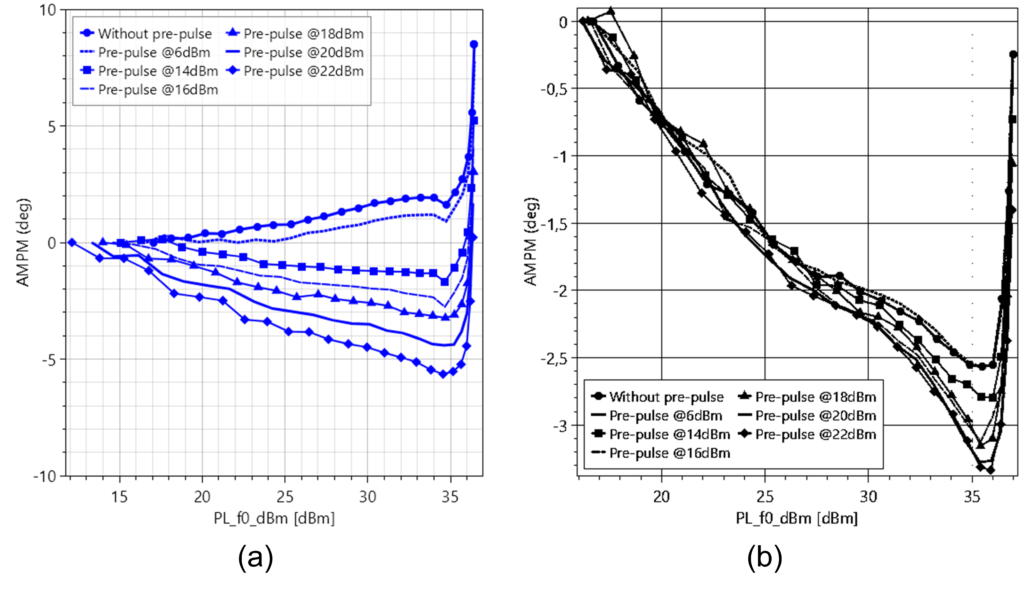
GaN power devices used in radar, wireless infrastructure, and pulsed RF systems can behave differently under dynamic operating conditions than under steady-state measurement. Charge trapping following large-signal RF stress can affect factors like gain, efficiency, and linearity, meaning measured performance depends in part on what the device experienced immediately beforehand.
This creates a challenge for conventional CW and single-pulse Load Pull characterization. During power or impedance sweeps, each load point may be measured after a different history of RF stress, so the device may be in a different trapping state from one measurement to the next. This makes it difficult to compare device performance under a consistent, defined trapping condition.
RF Double Pulse Load Pull
The Maury Microwave MT2000 Mixed-Signal Active Load Pull System provides an RF Double Pulse Load Pull methodology designed to overcome this limitation. Rather than allowing the DUT’s previous measurement history to determine its starting condition, the technique uses two RF pulses to separate device conditioning from the RF measurement.
The first pulse, or RF pre-pulse, puts the device through a defined operating condition to establish a controlled trapping and thermal state. After a programmable interval, a second, shorter pulse is used to measure the device’s performance before significant trap emission occurs. Repeating this sequence at each impedance condition gives every Load Pull measurement a consistent, controlled device history.
Measuring the Effects of Prior RF Conditioning
A gain-versus-output-power measurement shows how a device’s amplification changes as its RF output power increases. At lower power levels, gain is generally relatively stable. As the device is driven toward compression, its gain begins to decrease, showing where the amplifier is no longer responding proportionally to increased input power.
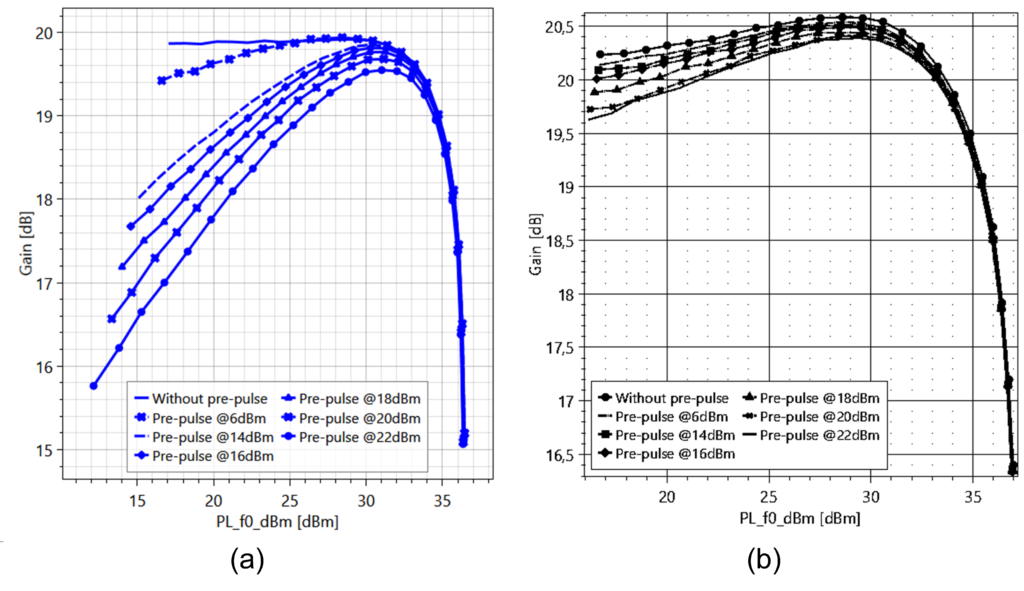
The gain-versus-output-power graph below shows how prior RF conditioning can affect the gain measured immediately afterward in two different GaN technologies. The measurements compare:
- No pre-pulse: Gain is measured without first applying an RF conditioning pulse.
- Lower-power pre-pulse: The device is conditioned at a lower RF power level before gain is measured.
- Higher-power pre-pulse: The device is conditioned at a higher RF power level before gain is measured.
For Device (a), changing the pre-pulse power produces significant differences in measured gain, particularly at backed-off output powers. Device (b) shows less variation. This demonstrates that a device’s prior RF condition can influence the performance measured immediately afterward and that the magnitude of this effect can vary between GaN technologies.